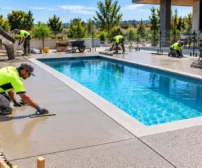

Choosing the right concrete pump can make a major difference to how smoothly a concrete pour runs. The pump needs to suit the size of the pour, the distance the concrete must travel, the height it needs to reach, site access, and the type of concrete placement required.
So, what size concrete pump do I need for a residential or commercial project in Canberra? There is no single pump size that suits every job. A driveway, house slab, backyard extension and multi-level construction project can have very different pumping requirements.
The right choice is based on the site rather than simply choosing the largest available machine. A properly selected Concrete Pump can help deliver concrete efficiently while reducing unnecessary handling and making difficult-access pours more manageable.
In Canberra, local site conditions can also influence pump selection. Narrow driveways, sloping blocks, established landscaping and restricted access can all affect how equipment is positioned and how concrete reaches the pour area. Local pumping providers commonly assess access, reach and project requirements before selecting equipment.

What Determines the Size of a Concrete Pump?
“Pump size” is not necessarily a translation of reality. It’s not just about the length of the truck.
When making an assessment of a pumping requirement, a number of items should be taken into account:
- The amount of concrete placed
- Horizontal pumping distance
- Vertical pumping distance
- Site access
- Available setup space
- Pour location
- Concrete mix characteristics
- Required placement rate
- Obstacles around the property
- A construction project of any sort.
A small pump was very appropriate for one project but not for another if the concrete is to be pumped a great distance or to a different elevation.
For this reason, site requirements are to be the initial criteria in selecting a pump, rather than just the volume of concrete to be pumped.

Concrete Pump Size & Pump Reach
It’s important to make this distinction: pump size and reach.
A pump could be small in physical size, but be very useful for a project in which the concrete must be pumped through a line to a difficult site. Another machine may be fitted with a long placing boom to extend across a site or to higher locations.
For instance within Canberra pumping providers, they could be from line pumps and smaller mobile pumps to large boom pumps and specialised placing systems. Different lengths of boom are available for local fleets based on provider and project specifications.
It does not mean that the question should just be:
How many cubic yards of concrete are required?
It should also be:
So, where will the concrete be going and how will it be transported there?
The second question can have a much greater bearing on the choice of equipment.
What Size Concrete Pump Do I Need for a Driveway?
One of the typical concrete applications that can benefit from pumping are driveways, especially when the access from the street to the pour area is limited.
The equipment for a typical driveway might not be the same as that needed for a large commercial slab. The proper setup, however, will depend on the driveway layout and the distance between the concrete delivery truck and the area where the concrete is placed.
Relatively simple requirements might apply to a driveway that is directly connected. A house that has a small entry, retaining wall, landscaping or a long way from the back of the block might need a different pumping system.
Suburban property designs in Canberra may differ significantly. Existing built-up property can present obstacles in terms of narrow side access, existing structures and fences and gardens, which can make it difficult to deliver concrete directly to the site.
In these projects, the pumping team should take into account:
- The distance from the pump to the point where it can be safely placed.
- On sites where concrete trucks can get to the site
- Distance to the driveway
- If you don’t have a boom or hoses, whether it is possible to reach the placement area.
- Space for working, which may be limited.
- The correct pouring procedure for the paperclip.
The most suitable concrete pump Canberra solution, then, is the one that is applicable to the specific driveway configuration and not just the pump that has the greatest capacity.

What Size Pump Is Suitable for a House Slab?
House slabs generally require careful planning because the concrete needs to be placed across a relatively large area while reinforcement and formwork are already prepared.
The required equipment can depend on the slab’s size, shape, access and the distance between the pump and the furthest placement point.
A straightforward site with good vehicle access may have different requirements from a block where the slab is behind the house or where the concrete truck cannot get close to the pour.
For a house slab, the pumping team may consider:
Slab dimensions
The larger the slab, the more concrete may need to be placed during the pour. A larger volume does not automatically mean a larger pump, but it can influence the required pumping capacity and pour planning.
Site layout
The pump needs a suitable position from which concrete can be delivered efficiently. Buildings, fences and neighbouring properties may limit positioning options.
Pour sequence
Large slabs are often planned in sections or according to the construction sequence. The pumping arrangement needs to support the planned movement and placement of concrete.
Access
Access is particularly important on residential blocks. A narrow driveway or restricted side access can change the most practical pumping method.
Local Canberra providers describe concrete pumping as suitable for house slabs, foundations, driveways and other residential applications, including projects where site access presents challenges.
When do you need a bigger concrete pump?
A larger pump may be needed if the project calls for a longer reach or higher placement or a quicker delivery rate.
This can occur on:
- Large commercial slabs
- Multi-level buildings
- Large foundations
- Industrial projects
- Infrastructure works
- Elevated concrete placement
- Websites that have a considerable horizontal or vertical span.
Some Canberra pumping companies have equipment that will have their booms ranging in length across different ranges, to enable equipment to be matched to site conditions. JAG Concrete Pumping, for instance, has smaller sizes, up to larger sizes of boom pumps, line pumps and special boom systems.
But a longer boom isn’t necessarily the answer.
There must be sufficient space for safe operation, suitable ground and access. While a pump may be technically capable of gaining access to a site, it might not be feasible due to the lack of space to position the pump safely.
When Is a Smaller Pump More Practical?
In areas of limited space or where greater reach is not necessary a smaller pumping unit may be helpful.
Examples may include:
- Residential driveways
- Footpaths
- Small slabs
- Extensions
- Backyard areas
- Renovation projects
- Tight-access concrete work
For smaller or medium-sized projects, flexible hose placement may be necessary to deliver concrete around buildings or through restricted project areas, and it is generally placed in the concrete by a line pump. According to Canberra providers, line pumping may be helpful for residential slabs, driveways, footpaths, as well as challenging locations.
Remember the reason is that “smaller” doesn’t necessarily mean “less capable” in every case.
When the access is the major concern, and not the height or extreme reach, then a compact set-up might be the best solution.

How Much Concrete Are You Pouring?
Another key factor to consider is the volume of concrete.
The project team should have a general idea of the amount of concrete that will be needed before choosing a pump. This assists in deciding the approximate time of the pour and the pumping needs.
Volume may be estimated for a simple rectangular slab by its length, width and thickness. For more complex shapes, separate calculations might be needed for various sections.
However, when selecting the pump the volume of concrete should not be the sole criteria.
Suppose you have two projects, both demanding the same amount of concrete:
Project A:
Direct access of the concrete truck to the pour area.
Project B:
The concrete must be moved around a building and to a back half of the land.
It may be a similar concrete volume but the pumping needs may be considerably varied.
This is why experienced operators check the site before confirming equipment.
Horizontal Distance Matters
The horizontal separation between the pump and placement point can significantly influence the pumping system.
If there is a pump near the pour point, a simple delivery can be used. Depending on how far away the placement area is from the available pump location, a longer delivery line may be necessary or a different pumping configuration.
This is particularly an issue for:
- Long driveways
- Rear-yard slabs
- Large residential blocks
- Commercial sites
- Projects that involve the rehabilitation of existing structures.
- Projects within existing structures.
- Difficult-access locations
This is location dependent too. Sometimes it may not be possible to have a straight line.
Sometimes the delivery system must go around buildings and or around restricted areas, and the pumping crew must know exactly how the pour is going to go before the pour commences.
Vertical Reach is Just as Important
Pump size may be an important consideration.
When concrete is required to be pumped above ground level the equipment must be capable of operating at the necessary height and have a suitable pumping arrangement.
This can apply to:
- Multi-storey construction
- Suspended slabs
- Elevated structures
- Tall retaining structures
- High-rise developments
Boom pumps are frequently utilized in scenarios where concrete has to be pumped into height or into larger areas. Boom equipment is available for high rise, commercial and large scale applications with Canberra pumping equipment providers.
A structure and access consideration should be made by the pumping co prior to booking for elevated projects, as well as the required reach (and sequence of placement).
Site Access Can Change the Pump You Need
Access is one of the most forgotten things when it comes to selecting a pump.
A machine can be technically capable but it may not be suitable if it is not able to safely reach the property or if it is not in the correct position.
Prior to ordering a concrete pump Canberra service, review:
- Driveway width
- Gate width
- Overhead clearance
- Turning space
- Ground conditions
- Nearby structures
- Hazards from power lines and other overhead structures
- Distance from the road to the pour
Equipment set up space is required.
Access conditions to Canberra properties can be a combination of access. The new development can feature open construction areas, and the established suburbs can have mature landscaping, fences and existing buildings.
These problems can be identified with a site assessment before concrete is laid.
Does Concrete Mix Affect Pump Selection?
Yes. The quality of the concrete is also important.
The cement paste, fine aggregate and coarse aggregate make up concrete. It affects the workability and mix properties, which can affect ease of pumping.
The concrete mixture requirements should be worked out with the concrete pump supplier and the concrete pumping operator.
Factors may include:
- Aggregate size
- Concrete consistency
- Required strength
- Additives
- Temperature
- Delivery conditions
- Pumping distance
Always, the correct mixture has to be specified for the structural and project requirements. Then the pumping equipment should be chosen to function properly in conjunction with that concrete.
Why the Biggest Pump Is Not Always the Best Pump
When deciding on the pump’s size, it may seem like the obvious choice is to go with the biggest pump available, but this is not always the case.
Larger equipment can, however, take up more set up space and not be suitable for all residential and/or restricted access installations.
For instance, using a large boom pump is not necessary for the small backyard pour and the smaller pumping system can pump the concrete just as effectively.
The idea is not to go for the largest machine.
The objective is to identify the most appropriate equipment to use.
The right pump can compensate for reach, access, capacity, placement and site conditions.
What Should You Tell a Concrete Pumping Company?
When you’re asking a provider “what size concrete pump do I need?” you should have as many details of the project as you can.
Useful details include:
1. Project type
Describe if the project is a driveway, house slab, shed slab, footing, patio or other slab application.
2. Concrete volume
If known, provide the estimated amount of concrete to be used.
3. Web address or location
The location provides a general idea of the site and access needs to the provider.
4. Pour location
Describe the location for the concrete truck stop and the placement areas for the concrete.
5. Distance
Estimate the horizontal and vertical distance between the position of the pump and the furthest position where the pump will be placed.
6. Access restrictions
Point out narrow driveways, overhead obstacles, steep areas, gates and fences.
7. Pictures or drawings of the site.
Photos can aid a pumping company in understanding the configuration prior to their arrival. If you are embarking on a larger construction project, a site plan can prove to be useful.
This information will help you to make an easier selection of equipment at this early stage.
Choosing the Right Concrete Pump in Canberra
Rather than just equipment size, consider the suitability of the best concrete pump Canberra choice when it comes to finding the most suitable Concrete Pump for projects.
A good pumping provider ought to be able to talk about the project, and the reasons why a specific arrangement is suitable.
Ask yourself if the provider might be able to:
- Evaluate site needs
- Make the selection of the pump clear.
- Provide an experienced operator to:
- Work with concrete supplier
- Follow your pour schedule.
- Address limited access issues
- Follow appropriate safety procedures
- Ensure equipment is matched to the required reach
The Concrete Pumping Association of Australia provides a searchable member directory with options for state and category – including concrete pumping contractors.
If the project is local, it can also be good to select a provider who is already aware of Canberra locations.
Common Mistakes When Choosing Pump Size
Several mistakes can create unnecessary problems on pour day.
Choosing based only on concrete volume
The amount of concrete matters, but it is only one part of pump selection.
Ignoring access
A pump must be able to reach and set up at the site safely.
Forgetting the furthest placement point
The closest part of the slab may be easy to reach, but the furthest point could determine the actual pumping requirement.
Not checking overhead clearance
Boom equipment requires adequate space to operate. Overhead obstacles need to be identified before setup.
Leaving equipment selection until the last minute
Late planning can make it harder to find suitable equipment for the required date and pour sequence.
Assuming the largest machine is automatically better
A larger pump is not necessarily the most practical choice for every project.
A Simple Way to Think About Pump Selection
If you’re still asking, “what size concrete pump do I need?”, think about the project in five steps:
Step 1: Measure the project
Know the approximate size and concrete volume.
Step 2: Identify the pour location
Determine exactly where concrete needs to be placed.
Step 3: Measure the distance
Consider both horizontal and vertical reach.
Step 4: Check site access
Look at driveway width, setup space, overhead clearance and obstacles.
Step 5: Discuss the project with the pumping operator
The operator can use these details to determine an appropriate pumping arrangement.
This approach is more reliable than selecting equipment based on pump size alone.
Final Thoughts
The answer to “what size concrete pump do I need?” depends on more than the amount of concrete being poured. Reach, height, site access, concrete characteristics, pour location and project type all influence the equipment required.
For a straightforward residential project, a compact pumping setup may be practical. Larger slabs, commercial construction and elevated projects may require equipment with greater reach and capacity. Difficult-access sites can require a different approach again.
For Canberra projects, early planning is especially useful when properties have narrow access, slopes, landscaping or limited space for equipment.
The most suitable Concrete Pump is the one that can safely and efficiently handle the actual conditions of your site. By providing accurate project details to an experienced pumping operator before the pour, you can make equipment selection easier and reduce avoidable delays on concrete day.
If you are planning a driveway, slab, footing or commercial concrete project in Canberra, discuss the site layout, concrete volume, pumping distance and access conditions with your chosen pumping provider before booking equipment.
Contact Information
Phone: 0431 961 460
Email: info@canberraconcretepump.com
Website: https://concretepumpcanberra.com.au/
Planning a concrete pour in Canberra? Contact Concrete Pump Canberra to discuss your project and pumping requirements.